
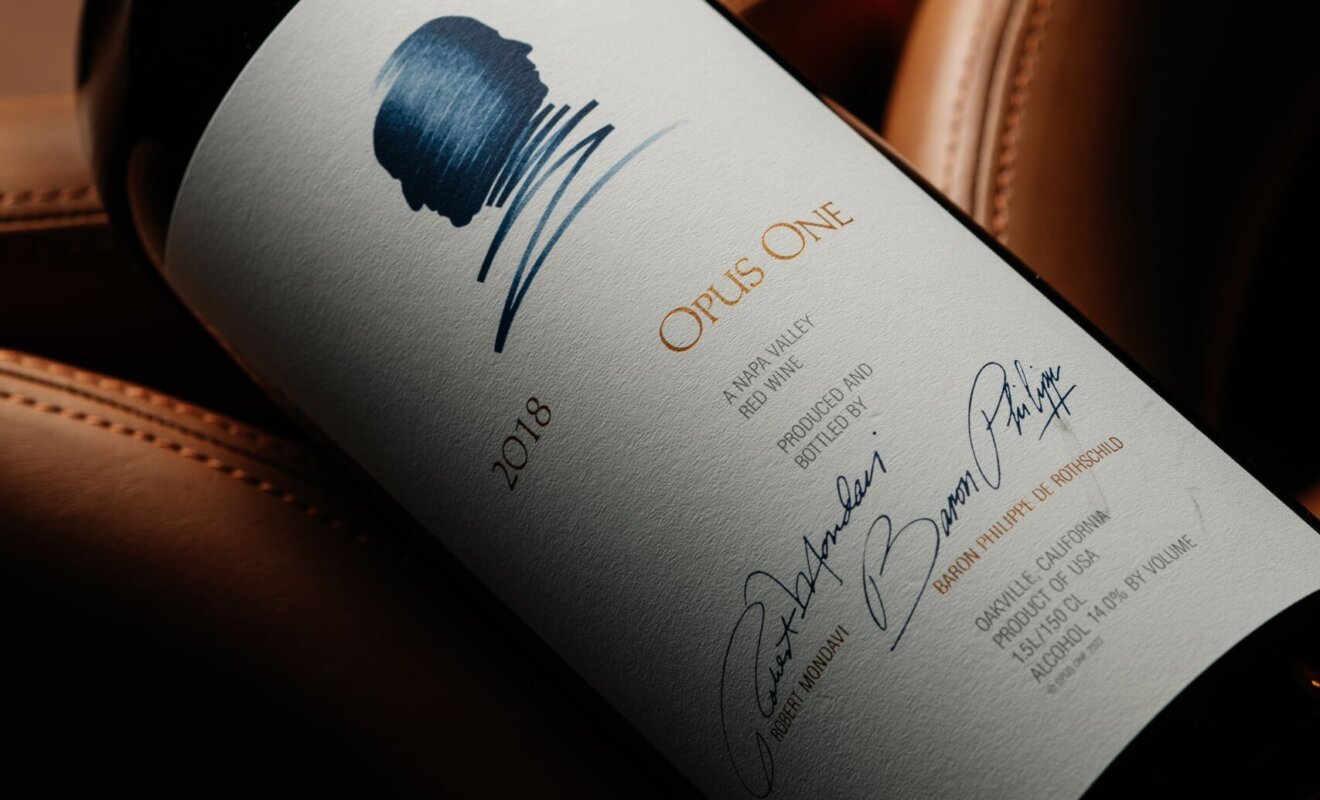
Few wines carry as clean an origin story as Opus One. It began not in a boardroom but at a resort on Hawaii’s Big Island, where two winemakers from opposite sides of the world discovered they wanted to build the same thing. Nearly fifty years later, Opus One is still one of the clearest examples of what happens when Napa Valley fruit meets a Bordeaux blending philosophy — and it remains one of the wines that best explains why “California Bordeaux blend” is its own category, distinct from both Bordeaux itself and from the varietal wines most American drinkers grew up with.
The Meeting That Started It All
Robert Mondavi and Baron Philippe de Rothschild of Château Mouton Rothschild met in 1970, and the idea of making a single wine together took most of the decade to become real. Mondavi brought the vineyard, the site knowledge, and a distribution network built over more than a decade in Oakville. Rothschild brought Bordeaux winemaking tradition and the credibility of one of Pauillac’s First Growth estates. The partners formally announced the joint venture in 1980, with the first fruit already harvested and vinified the year before, in 1979, at the Robert Mondavi Winery.
The wine spent its earliest vintages without the name it carries today. It was labeled “Napamedoc” internally before the partners settled on “Opus One” — a name meant to signal a first, defining work, the way a composer numbers a debut piece. The 1979 and 1980 vintages were released together in 1984, and the wine quickly became one of the most closely watched releases in American wine.
What Makes Opus One a Bordeaux-Style Wine
“Bordeaux-style” or “Bordeaux blend” describes a wine built from the grape varieties historically used on the Left Bank of Bordeaux, rather than a wine made from a single variety. Opus One is built primarily around Cabernet Sauvignon, with Petit Verdot, Merlot, Cabernet Franc, and small amounts of Malbec filling out the blend depending on the vintage. The 2018 wine, for example, leans heavily on Cabernet Sauvignon, with Petit Verdot as the second-largest component and the remainder split between Merlot, Cabernet Franc, and a touch of Malbec.
This is the opposite approach from how most Napa Cabernet is made. A varietal Cabernet Sauvignon only needs to be 75% Cabernet under U.S. labeling rules; a Bordeaux-style blend is built deliberately from several varieties working together, the way a winemaker in Pauillac or Saint-Julien would approach a vintage — adjusting proportions each year to balance structure, fruit, and aromatics rather than chasing a fixed formula.
The Grapes Behind Opus One
The estate grows all five red Bordeaux varieties on its Oakville vineyards: Cabernet Sauvignon, Cabernet Franc, Merlot, Malbec, and Petit Verdot. Cabernet Sauvignon typically dominates, but the supporting varieties shift the wine’s character from vintage to vintage — Petit Verdot for color and structure, Merlot for roundness, and Cabernet Franc for lift and aromatics.
Understanding Meritage: A Category Guests Still Ask About
This is where the confusion usually starts. Many guests hear “Bordeaux blend” and assume there must be an official American term for it — and there is, but Opus One doesn’t use it.
In 1988, a group of Napa and Sonoma vintners founded what’s now called the Meritage Alliance, created specifically because U.S. labeling law had no good way to describe a red wine blended from multiple Bordeaux varieties without misleadingly calling it “Cabernet Sauvignon” or a generic “red table wine.” The name “Meritage”—a blend of “merit” and “heritage”—was chosen in a nationwide contest and trademarked. To use the term legally, a winery must license it and follow specific rules: a red Meritage must combine at least two recognized Bordeaux varieties, with no single grape exceeding 90% of the blend.
Meritage vs. Bordeaux Blend
“Bordeaux blend” is a style description anyone can use. “Meritage” is a licensed trademark that only member wineries can put on a label. Every Meritage wine is a Bordeaux blend, but not every California Bordeaux blend is labeled Meritage — most producers simply give their wine a proprietary name instead, the way Opus One did.
Why Opus One Isn’t Officially Labeled Meritage
The math explains the confusion well: Opus One’s first vintage was 1979, and the Meritage trademark wasn’t created until 1988 — nearly a decade later. By the time the category existed, Opus One already had its own name, its own reputation, and no reason to license a term it helped inspire. It’s a California Meritage-style wine in every practical sense, built from the same “noble” Bordeaux varieties under the same principle, but you won’t find the word on the label. Guests who know the term Meritage but not this history often assume there’s a stricter distinction than there actually is.
The 2018 Vintage
2018 in Napa Valley is generally remembered as an even, generous growing season — mild temperatures through the summer, a long hang time, and a harvest that came in with good ripeness and retained acidity. It’s the kind of year that tends to favor Cabernet-based blends, giving winemakers fruit with enough structure to age while keeping the wine from tipping into heaviness. Terra Brooklyn currently carries the 2018 Opus One in 1.5L format on its wine list.
Large Format and Why It’s on the List
A 1.5L bottle, or magnum, holds the same wine as two standard 750ml bottles but ages more slowly. The ratio of wine to the small amount of oxygen trapped under the cork is lower in a larger bottle, which tends to soften a wine’s evolution over time — one of the reasons collectors and restaurants alike favor magnums for age-worthy Cabernet-based wines like this one. For a restaurant wine list, it’s also simply a practical way to serve a structured, full-bodied blend to a table sharing a meal over multiple courses.
Pairing Opus One With Dinner
Bordeaux-style blends built around Cabernet Sauvignon generally want food with some fat and structure of its own — the tannins in the wine need something to grip against, or they can taste austere on their own. Roasted or grilled red meats are the classic match, along with dishes built around mushrooms, aged cheeses, or rich sauces that can stand up to a full-bodied red. It’s the kind of wine suited to a slower dinner rather than a quick glass at the bar, which is part of why it tends to show up on multi-course dinner menus rather than by-the-glass lists.
Where to Explore Opus One in Brooklyn
Wines with this kind of history don’t come around often on a neighborhood wine list, and guests searching for fine dining near me in Sheepshead Bay won’t find many restaurants pouring a bottle with this particular story behind it. At Terra Brooklyn, the wine and cocktail menu gives guests a way into wines like this one, alongside a full dinner menu of European-inspired dishes designed to hold their own next to a structured Cabernet blend.
FAQ
Is Opus One a Bordeaux wine?
No. Opus One is made in Oakville, in California’s Napa Valley. “Bordeaux-style” or “Bordeaux blend” describes the grape varieties and blending approach, not the wine’s origin — true Bordeaux wine has to come from the Bordeaux region of France.
What grapes are in Opus One?
Cabernet Sauvignon, Cabernet Franc, Merlot, Malbec, and Petit Verdot — the five red grape varieties traditionally associated with Left Bank Bordeaux blending.
Is Opus One a Meritage wine?
It’s built the same way as a Meritage wine — a blend of multiple Bordeaux varieties — but it doesn’t carry the licensed Meritage name on its label, largely because Opus One predates the Meritage trademark by almost a decade.
Who founded Opus One?
Napa Valley vintner Robert Mondavi and Baron Philippe de Rothschild of Château Mouton Rothschild, following a partnership that began in 1970 and was formalized in 1980.
What does Opus One taste like?
As a Cabernet Sauvignon-led Bordeaux blend, it’s typically full-bodied with firm tannins, dark fruit character, and the structure to age — though exact character shifts from vintage to vintage with the blend proportions.
Visit Terra Brooklyn
Curious to taste the story firsthand? The 2018 Opus One is part of the current wine list at Terra Brooklyn, in Sheepshead Bay. Reserve a table for dinner and explore it alongside the rest of the menu.